Top Web Development Trends to Watch in 2026
From AI-integrated websites to search-engine-and-AI-friendly architecture, here are the web development trends shaping 2026 — explained by Syntaxtro

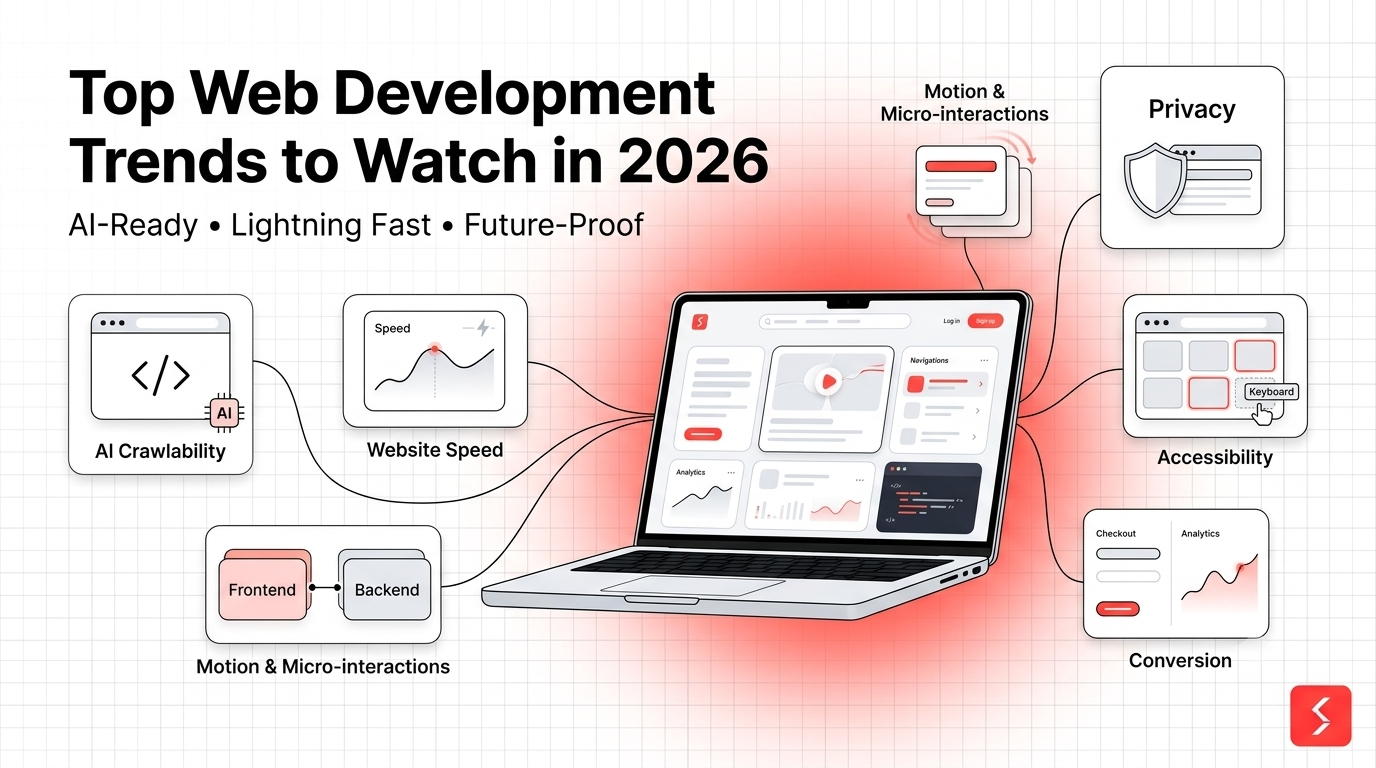
Websites in 2026 are expected to do more than just look good—they need to load instantly, work flawlessly on every device, and increasingly be readable by AI systems as well as humans. These are the trends shaping how modern websites are built and how Syntaxtro develops high-performing digital experiences.
If you're planning a new website, explore our Website Development Services:
https://syntaxtro.com/services/website-development
1. AI-Readable, AI-Crawlable Websites
As more users discover businesses through AI tools like ChatGPT, Google Gemini, and Google AI Overviews, websites need to be built so AI crawlers can understand their content—not just traditional search engine bots.
Learn more about Google's AI-powered search experience:
https://blog.google/products/search/
This means:
- Avoiding critical content locked behind heavy JavaScript rendering
- Using clean, semantic HTML
- Making sure the robots.txt file doesn't accidentally block AI crawlers
- Implementing structured data (Schema.org markup) throughout the site
Learn about Schema Markup:
https://schema.org/
If you want your website optimized for both Google Search and AI search engines, check out our SEO Services:
https://syntaxtro.com/services/seo
2. Speed Is Non-Negotiable
Page speed has moved from a "nice-to-have" feature to a business requirement. Faster websites provide a better user experience, improve conversion rates, and rank higher in search results.
Modern optimization techniques include:
- Image optimization
- Lazy loading
- Code minification
- Lightweight frameworks
- CDN implementation
Test your website here:
Google PageSpeed Insights
https://pagespeed.web.dev/
3. Headless and Composable Architecture
More businesses are separating their content management system from their front-end presentation layer using a headless CMS. This provides greater flexibility, improved performance, and easier scalability while allowing content teams to manage websites without developer involvement.
Popular headless CMS platforms include:
4. Micro-Interactions and Purposeful Motion
Subtle animations—such as button hover effects, scroll-triggered reveals, and smooth page transitions—are being used strategically to improve user experience rather than simply adding visual flair.
Good motion design helps users:
- Navigate more naturally
- Understand interactions
- Increase engagement
- Improve conversions
Our UI/UX Design team focuses on user-first experiences:
https://syntaxtro.com/services/ui-ux-design
5. Privacy-First, Cookie-Light Design
As privacy regulations continue to evolve and browsers phase out third-party cookies, websites are relying more on first-party data collection and privacy-friendly analytics.
Read about Google Analytics 4:
https://support.google.com/analytics
Privacy-first websites help businesses:
- Build user trust
- Improve compliance
- Collect more meaningful customer insights
6. Accessibility as Standard Practice
Accessibility is no longer optional. Modern websites should support:
- Proper color contrast
- Keyboard navigation
- Screen-reader compatibility
- Responsive typography
- Accessible forms
Learn more from the W3C Web Accessibility Initiative:
https://www.w3.org/WAI/
Accessible websites serve more users while improving SEO and overall usability.
7. E-commerce and Booking Flows Built for Conversion
Whether you're selling products or services, today's websites focus on reducing friction throughout the customer journey.
Best practices include:
- Guest checkout
- Mobile-first design
- Faster checkout processes
- Multiple payment options
- Simplified booking forms
Need an online store? Explore our E-commerce Development Services:
https://syntaxtro.com/services/ecommerce-development
What This Means for Your Business
If your website was redesigned more than 2–3 years ago, it's likely missing several of these modern standards—especially AI crawlability, which has become increasingly important with the rise of AI-powered search.
A professional website audit can quickly identify opportunities to improve speed, accessibility, SEO, user experience, and AI visibility.
Learn about our Website Development Services:
https://syntaxtro.com/services/website-development
Frequently Asked Questions
Do I need to rebuild my whole website to keep up with these trends?
Not necessarily. Many improvements—such as speed optimization, Schema markup, accessibility enhancements, and technical SEO—can often be added to an existing website without requiring a complete redesign.
Is a headless CMS worth it for a small business?
Usually not for smaller websites. However, if your business requires greater flexibility, faster performance, or complex content management, a headless architecture can be an excellent investment.
How do I know if my site is readable by AI crawlers?
A technical SEO audit can evaluate your:
- robots.txt configuration
- JavaScript rendering
- Structured data
- Crawlability
- Site architecture
Syntaxtro includes these checks as part of every comprehensive SEO audit.
Learn more about our SEO services:
https://syntaxtro.com/services/seo
Ready to Future-Proof Your Website?
Whether you need a brand-new website or want to improve your existing one, Syntaxtro can help you build a fast, secure, AI-friendly, and conversion-focused website that is ready for 2026 and beyond.
Request your free website audit today:
https://syntaxtro.com/contact
More Dispatches & Essays
How to Choose the Right Software Development Company in 2026
A practical checklist for choosing a software development company what to ask, red flags to avoid, and why Syntaxtro is trusted by clients in Islamabad and worldwide.
SoftwareWhy Global Businesses Are Outsourcing Software Development to Pakistan
Pakistan, and Islamabad specifically, has become a go-to destination for outsourced software development. Here's why—and what to look for in a partner like Syntaxtro.